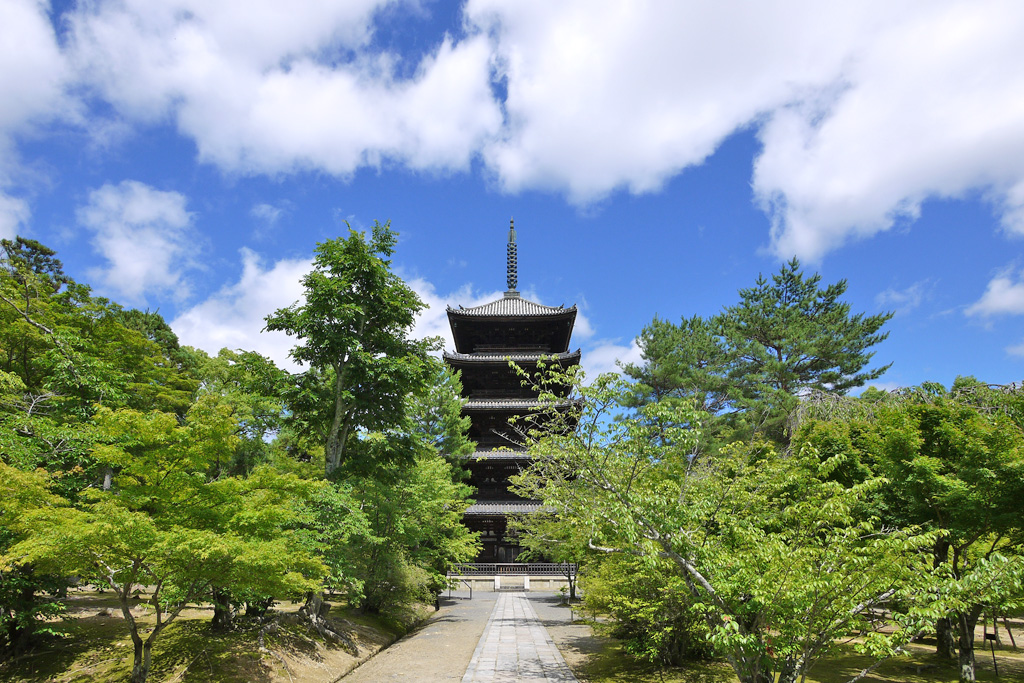
Nestled in the northwestern reaches of Kyoto, Ninna-ji is a historic Buddhist temple whose story spans over a millennium. Founded in 888 CE, it remains today a profound symbol of Japan’s cultural, imperial and religious heritage — a place where the elegance of ancient architecture, the tranquility of garden and nature, and the silent weight of history converge. ウィキペディア+2京都市+2
Visiting Ninna-ji is like stepping across time: through its grand gates, serene courtyards, and venerable halls, one can almost sense the whisper of emperors, monks, poets and pilgrims who have walked here across generations.
The origins of Ninna-ji date back to 886, when 光孝天皇 (Emperor Kōkō) ordered the construction of a temple — then called “Nishiyama Gogan-ji” — to bring blessings upon the nation and promote Buddhist teachings. 〖京都市公式〗京都観光Navi+1 However, the emperor passed away the following year, before seeing the temple’s completion.
His successor, 宇多天皇 (Emperor Uda), carried on his predecessor’s wish. In 888 CE, the temple was completed, and was named “Ninna-ji” after the imperial era name “Ninna.” 仁和寺+1
In 897, after abdicating the throne, Emperor Uda took Buddhist vows and became the first head priest (monzeki) of Ninna-ji. He established his residence within the temple grounds — known as the “Omuro” (御室) — giving rise to the term “Omuro Gosho” (御室御所), meaning the “Omuro Imperial Palace.” Japan Travel+2Traditional Kyoto+2
From that time until the late Edo period, successive head priests of Ninna-ji were drawn from the imperial family or aristocracy — making Ninna-ji the first and foremost of Japan’s “monzeki” temples. Japan Guide+2エヌティーエー+2
Over the centuries, Ninna-ji flourished, with many subsidiary temples and a vast estate. Yet, in 1467 the temple was caught up in the ravages of the 応仁の乱 (Ōnin War). The turmoil and fires reduced most of the temple complex to ashes; much of its grandeur was lost. 仁和寺+2ホネット+2
For roughly 150 years, the temple lay in ruins — its ex-monastic lands abandoned, many records lost, its treasures hidden or relocated. 京都画уу+2ホネット+2
The turning point came in the early Edo period. In 1634, the 21st head priest of Ninna-ji petitioned 徳川家光 (Tokugawa Iemitsu), the third shōgun of the Tokugawa shogunate, for support to rebuild the temple. Thanks to his backing — along with imperial patronage associated with the rebuilding of the Kyoto Imperial Palace — reconstruction began. 仁和寺+2ホネット+2
By 1646, much of the temple was restored. Several buildings of the old Imperial Palace, including the Shishinden and Seiryō-den, were relocated to Ninna-ji and became its Main Hall (Kondō) and other structures. New gates, halls, and the iconic pagoda were erected, giving the temple a renewed life that in many ways defines the Ninna-ji we see today. 京都市+2お食事処 錦鶴 |+2
Through the Edo period and into modern times, Ninna-ji maintained its status as head temple of the 真言宗御室派 (Shingon Ōmuro school), continuing ancient Buddhist traditions, preserving cultural artifacts and serving as a link between imperial heritage and religious life. Japan Guide+2仁和寺+2
In 1994, Ninna-ji was officially designated a UNESCO World Heritage Site as part of the “Historic Monuments of Ancient Kyoto,” recognizing its outstanding universal value as a symbol of Japan’s cultural and historical legacy. ウィキペディア+2Kyoto Travel+2
One of the greatest strengths of Ninna-ji is how it fuses architecture, nature, and sacred space — giving visitors a layered experience that is at once spiritual, historical, and aesthetic.
As you enter, the first impression is made by the imposing wooden front gate known as the 仁王門 (Niōmon, “Two Kings Gate”). With its guardian statues and traditional irimoya-style roof, the gate stands as a powerful threshold between the everyday world and the sacred realm within. Discover Kyoto+2Kanpai Japan+2
Beyond the gate lie a network of pathways, halls, corridors, and gardens. Among them:
Walking through these buildings, one senses not only devotion but refinement: the delicate balance between architectural grandeur and contemplative calm.
Surrounding the halls and courtyards, Ninna-ji is graced by carefully tended gardens, with ponds, stone arrangements, bridges, and small tea houses — classic elements of Japanese garden design that offer peaceful spots to sit, reflect, or simply absorb the scenery. Kyoto Travel+2Japan Guide+2
But perhaps the most celebrated natural feature of Ninna-ji is its 御室桜 (Omuro-zakura) — a distinctive group of late-blooming cherry trees. These are relatively short trees (about 2–3 m), and unlike the iconic tall sakura of many Kyoto parks, they bloom later in the season, often when the main cherry-blossom wave has passed. ウィキペディア+2Discover Kyoto+2
In spring, when Omuro-zakura bloom, Ninna-ji transforms into a quietly magical space: blossoms framing ancient wooden roofs, petals drifting over stone paths, and an air of gentle transience that echoes Buddhist sensibility.
Because from its early years Ninna-ji was led by princes and imperial descendants, it has long stood at the crossroads of religion, politics, art, and culture. The tradition of imperial head priests (monzeki) endured for more than a thousand years — until the late Edo period. This unique status elevated Ninna-ji beyond a “mere temple”: it was (and is) a living institution where courtly culture, Buddhist ritual, artistic patronage, and aristocratic refinement intermingled. エヌティーエー+2Traditional Kyoto+2
During the Heian and subsequent periods, Ninna-ji — sometimes referred to as “Omuro Gosho” — counted many subtemples (subordinate temples) and flourished as a center of esoteric Buddhist practice, cultural preservation, and religious training. お食事処 錦鶴 |+2仁和寺+2
Over the centuries Ninna-ji accumulated a vast collection of sacred art, sculptures, Buddhist scriptures, calligraphy, and artifacts — many of which are now designated as National Treasures or Important Cultural Properties. Works include statues of Amida Nyorai (the principal deity), exquisite Buddhist paintings, ancient manuscripts and ritual objects. Some of these treasures are occasionally displayed to the public in exhibitions, providing glimpses into classical Buddhist art and imperial-era spirituality. 東京国立博物館+2Japan Guide+2
In this sense, visiting Ninna-ji is not just a tour of buildings and gardens — it is a journey into the rich tapestry of Japan’s religious and artistic heritage.
Today, Ninna-ji continues to function as the head temple of the Shingon Ōmuro school of Buddhism. Although much has changed over the centuries, the core spiritual purpose remains: a place for prayer, meditation, and the practice of esoteric Buddhist rituals. 仁和寺+1
The temple grounds also include a smaller pilgrimage path: a miniature version of the more famous Shikoku 88-temple pilgrimage, known among visitors as a gentle way to engage in spiritual walking without traveling far. Japan Travel+1
For many, Ninna-ji offers something rare in modern life: a chance to slow down, to reflect, to feel the quietly enduring pulse of history — and perhaps experience a kind of peace that only centuries-old temples can evoke.
If you plan to visit Ninna-ji, consider the following to make the most of your experience:
Ninna-ji is more than a tourist sight: it is a living monument, a testament to the resilience of culture, architecture, and spirituality. In its gates and halls — through the quiet rustle of cherry-blossom petals, the ancient wood of palace-halls, and the echo of centuries-old prayers — one senses a line stretching from the imperial courts of the Heian era to today’s Kyoto, unbroken by war, time, or change.
For anyone seeking a deeper glance at Japan’s soul — its history, religion, aesthetics, and quiet grandeur — Ninna-ji offers a rarely matched journey.
May your own visit there be peaceful, reflective, and memorable.
If you like, I can also draft a shorter (around 2000–3000 characters) English version of the above — suitable for readers who prefer a concise travel-blog post rather than a full historical essay. Would you like me to do that now?